
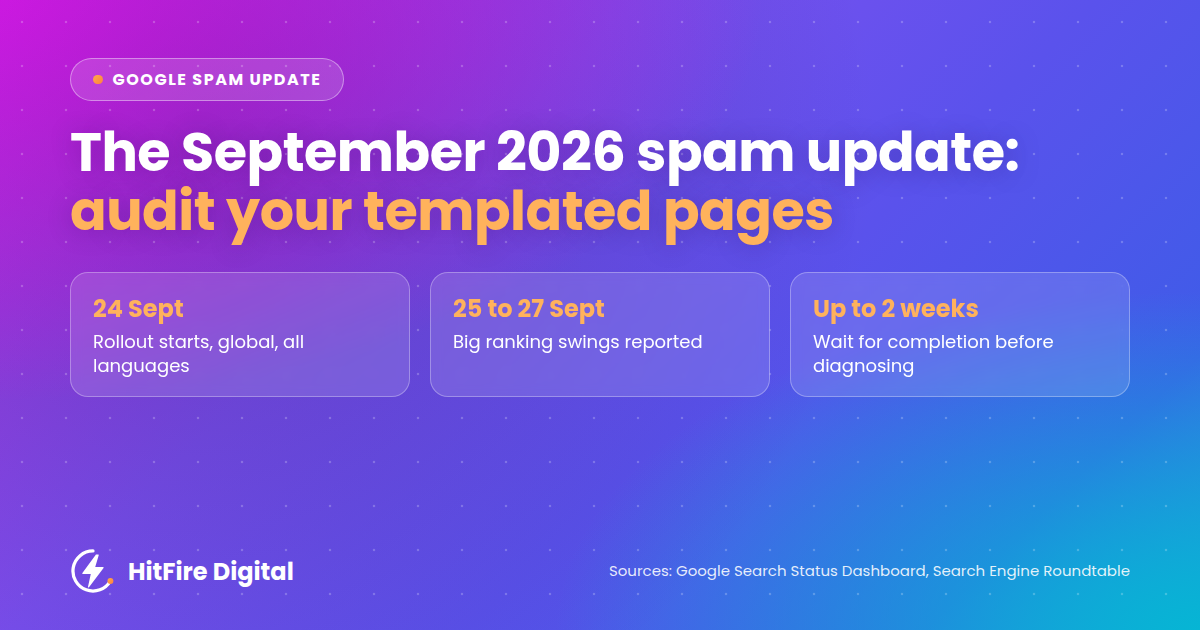
If your site runs on templates, the September 2026 spam update is the one to watch. Google started rolling it out on 24 September, and the first weekend brought some of the sharpest ranking swings we’ve seen this year. A second wave followed on 30 September.
Early reports point to sites with large volumes of templated, near-identical pages. Here’s what Google has confirmed, what is still speculation, and the audit I’d run on any programmatic section of a site right now. None of it involves panic-deleting pages.
What Google confirmed (and what it didn’t)
Google’s confirmation is short. On 24 September at 09:15 PDT, the Search Status Dashboard posted: “Released the September 2026 spam update, which applies globally and to all languages. The rollout may take up to two weeks to complete.”
That’s it. Google hasn’t said which spam behaviour this update targets. It hasn’t named page types, industries or tactics. At the time of writing the rollout is still running, so it could finish any day up to roughly 8 October.
What Google does say about spam updates in general is worth knowing. Its spam updates documentation tells affected sites to review the spam policies and make sure they comply. It also says improvement can come “over a period of months” as its systems learn that a site complies. A spam update isn’t something you fix by Friday.
What the early volatility suggests about templated pages
The tracking tools tell a clearer story than Google does. Search Engine Roundtable reported big movement from Friday 25 September through Sunday 27 September, with Saturday the most volatile day across the tools it tracks. A second wave hit on 30 September, and Glenn Gabe said several site owners emailed him about “a huge drop right on 9/30”.
The sites people are pointing to share a pattern: highly templated, programmatic pages, often one page for every variation of a thing. The example doing the rounds is one page for every phone number or area code.
Treat this as a strong signal, not a verdict. It comes from SEOs looking at affected sites, not from Google. Some sites with templated pages will be fine, and some sites with no templates at all will lose traffic for other reasons. But if a big share of your indexed pages come off the same template with only a keyword swapped in, you’re in the group that should be paying attention.
Why “AI-generated” is the wrong question
Every spam update brings the same panic: is Google penalising AI content? Wrong question. Google’s spam policy on scaled content abuse is about what the pages are for and what they give the reader, not how they were made. Google defines it as “many pages are generated for the primary purpose of manipulating search rankings and not helping users.”
The examples Google lists cover AI, scraping, and old-school keyword stuffing alike:
- “Using generative AI tools or other similar tools to generate many pages without adding value for users”
- “Scraping feeds, search results, or other content to generate many pages… where little value is provided to users”
- “Creating many pages where the content makes little or no sense to a reader but contains search keywords”
Google also updated its guidance on generative AI content on 1 October. It now says: “It is critical to manually fact-check and review all AI-generated content for accuracy and trustworthiness before publishing.”
So the test isn’t “did a human type this?” It’s “would this page deserve to exist if search engines didn’t?” A template that turns real data into a useful page passes. A template that swaps a city name into the same 400 words fails, whoever wrote them.
A five-step audit for programmatic pages
You can run this audit now, while the rollout finishes. It doesn’t need traffic data, so you don’t have to wait for things to settle.
- Check for unique data on every page. Pick 10 random pages from each template and read them side by side. Strip out the swapped keyword. Is there anything left that only that page has, like prices, availability, local details, reviews or specs? If two pages would still make sense with their headings swapped, they’re not really different pages.
- Match each page to real search intent. Does anyone actually search for this exact variation? Google’s spam policies describe doorway abuse as pages “created to rank for specific, similar search queries”. Fifty city pages for a service you deliver from one office, with nothing local on them, fit that description.
- Measure your index bloat. In Search Console, compare indexed pages per template against pages that earned at least one click in the last three months. A template with thousands of indexed URLs and a handful of clicking pages is your biggest risk and your easiest win.
- Follow your internal links. Templated pages are often linked only from sitemaps or giant footer blocks. If you wouldn’t link to a page from a real navigation path, ask why it should rank.
- Decide what to improve, merge or retire. Pages with real data and real demand: improve them. Near-duplicates targeting the same intent: merge them into one strong page and 301 the rest. Pages with no demand and nothing unique: noindex or remove them. Make these calls page group by page group, not in one big purge.
One warning: if you’ve been hit, don’t make big structural changes in the middle of the rollout. You’ll muddy your own data. Do the audit, plan the changes, and ship them once the update has finished.
When to read Search Console (and how)
Don’t diagnose until the rollout is finished. This update has already hit in at least two waves, so a chart you read today only shows part of the picture.
Google’s core updates guidance gives a method that works just as well here. Wait “at least a full week” after the update completes, then compare that week with the week before the rollout started. For this update, that means comparing a full week after the completion date with 17 to 23 September.
When you do look, slice the data so it tells you something:
- By page group, not site-wide. Filter the Performance report by URL pattern for each template. A site-wide drop can hide a template that fell off a cliff while the rest held steady.
- By query type. Separate branded from non-branded queries. If branded traffic held and long-tail templated queries fell, that points at the template.
- By surface. Check Discover and News separately if you get traffic there. Early reports mention losses in both.
If the drop lines up with the update dates and sits in your templated sections, you have your answer. If it’s spread evenly across the site, look for other causes before blaming the spam update.
The GEO connection: thin pages don’t get cited either
This update is about Google’s classic rankings, but the same pages are a problem in AI search too. When ChatGPT, Gemini or Google’s AI Mode builds an answer, it’s looking for a source that says something specific and checkable. A templated page with a city name swapped in rarely gives it that.
In the AI visibility audits I run, the pages that get cited tend to have three things in common:
- A clear, specific answer near the top, written for one question
- Facts only that page has, like real prices, real data or first-hand experience
- A clear entity behind it, meaning a real business with consistent details across the web
So the work you do for this spam update isn’t wasted effort spent pleasing one algorithm. Fewer, better pages built on unique information do better in Google’s rankings and are more likely to be the source an AI answer quotes.
The bottom line
Don’t panic, don’t mass-delete, and don’t read your data until the rollout is done. Use the next week to audit your templated sections honestly. Then ship the improvements, merges, and removals once the dust settles.
If you saw a drop after 24 September and want a second pair of eyes, I offer a short programmatic page review. I’ll look at your templates, your index, and your Search Console data, and tell you what to keep, merge, and retire. Get in touch through Hitfire Digital.