
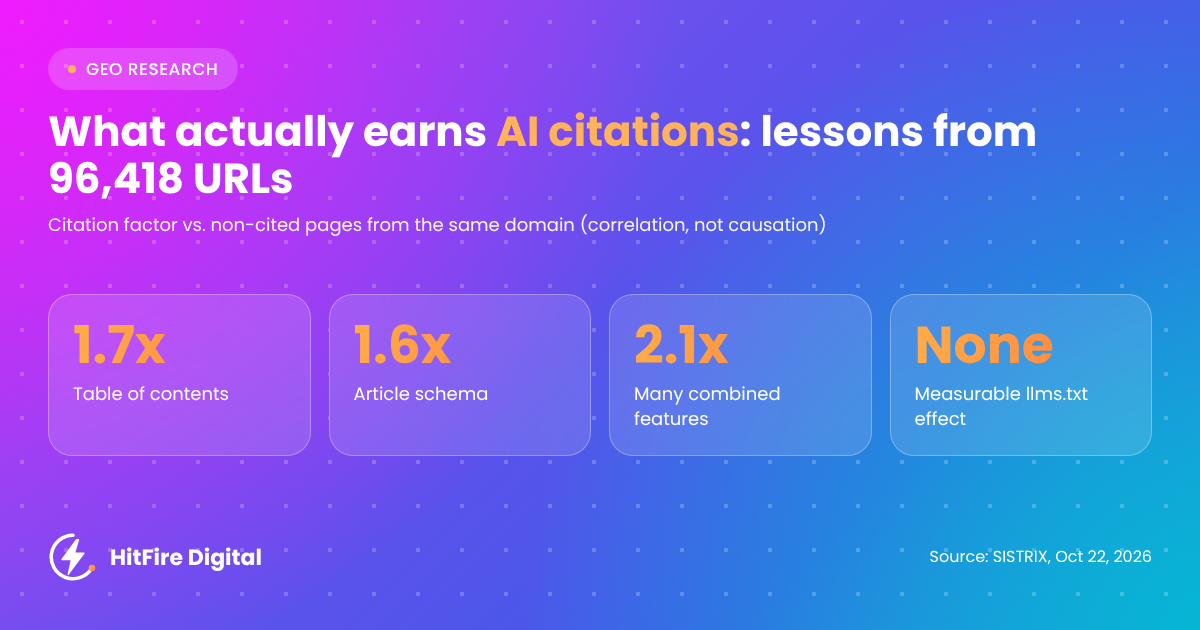
Most GEO advice is built on screenshots, anecdotes, and small samples. That is why the SISTRIX Citation Worthiness study, published on 22 October 2026, is worth slowing down for. It looks at 96,418 URLs from 17,380 domains and asks a simple question: when an AI system cites one page from a website and ignores another page from the same website, what is different about the cited one?
The short answer is structure. Pages with a table of contents, Article schema, clear H2 sections, and visible freshness signals were cited more often. Pages with an llms.txt file on their domain were not. And the study shows, with its own data, why so many smaller GEO studies have reached the wrong conclusions.
Below I break down what SISTRIX measured, which findings I would act on, which I would ignore, and the audit order I am now using on client sites. One caveat runs through all of it: these are correlations, not proof of cause. I will flag where my recommendations are professional judgement rather than something the data proves.
What SISTRIX measured, and why the method matters
The design is what makes this study more useful than most. SISTRIX started with 48,527 cited pages from its AI Index for the DACH region, collected in Q2 2026. Each cited page was paired with a page from the same domain that was not cited. In total, that gives 96,418 URLs from 17,380 domains, with 43 features recorded for every URL.
The pairing matters. If you compare cited pages with random pages from across the web, you mostly measure domain strength. Comparing pages on the same domain holds the brand, the backlink profile, and the site template roughly constant, so the differences that remain are about the page itself.
Three AI surfaces were covered, with about 16,000 cited URLs each:
- ChatGPT
- Google AI Mode
- Google AI Overviews
The analysis used conditional logistic regression with a Benjamini-Hochberg correction for multiple testing. In plain terms, SISTRIX controlled for the fact that if you test 43 features, a few will look significant by chance.
Results are reported as factors, where 1.0 means no difference. A factor of 1.7 means pages with that feature were cited 1.7 times as often as comparable pages without it.
Know the limits before you quote it to a client:
- It shows correlations, not proven causes. SISTRIX says this directly.
- Perplexity, Claude, and Gemini chat are not included.
- The data is from the DACH region, so treat it as directional for US and UK markets.
- Title and H1 features were analysed retrospectively, and SISTRIX describes them as initial indications.
The structural features that correlate with citations
Structure is the clearest pattern in the data. These are the features I would put at the top of any GEO content audit.
Table of contents: 1.7. Pages with a table of contents were cited 1.7 times as often, yet only 14% of pages in the study had one. That gap is the opportunity. A jump-link table of contents is cheap to add, and it gives AI systems a map of the page before they parse the body.
Article schema: 1.6. Article markup was one of the stronger signals overall, and in AI Overviews specifically it reached 2.0. If your editorial content runs on a CMS template without Article schema, fix the template once and every post benefits.
Five or more H2 headings: 1.6. SISTRIX warns that this partly reflects longer texts, so do not pad pages with headings. The useful reading is that pages broken into clear, self-contained sections are easier to quote from.
FAQPage schema: 1.5. This comes with SISTRIX’s own condition: “genuine questions rather than token FAQs”. Three generic questions bolted onto a service page are not what this number describes.
Word count of at least 1,000: 1.5. SISTRIX attributes this mainly to better structure rather than length. Longer pages tend to have more of the features above, so length is a side effect, not the lever.
The combined effect: 2.1. SISTRIX grouped eleven features. Pages that met many of them were cited 2.1 times as often as barely optimised pages, but only 10% of cited pages did. In my opinion, this is the most commercially useful finding in the study. Single tactics give small lifts. Doing the basics together is what separates pages.
Freshness and authorship signals
The second pattern is about trust cues a reader can see on the page.
Visible last-updated date: 1.3. Only 5% of pages showed one. That is a remarkably low adoption rate for something most CMS platforms can output in a single template change. If you update content, show it.
Author box with photo: 1.4. A named author with a face is a modest but consistent signal. For legal, financial, and health clients, where you should already have expert bylines, this is one more reason to make them visible rather than buried in schema alone.
Current year in the title: 2.7. This was the largest factor among the findings SISTRIX highlights, and the one most likely to be misused. Pages with only an older year in the title scored 0.7. SISTRIX is explicit that this is not a title trick, and notes the title and H1 analysis were added late. My reading: the year is a proxy for content that is maintained. Changing “2025” to “2026” on a page you have not updated is exactly the shortcut this finding does not support.
What did not move the needle, including llms.txt
The null results are as useful as the positive ones, because they tell you where to stop spending client hours.
llms.txt: no measurable effect. 11.7% of cited URLs came from domains with an llms.txt file, compared with 14.0% across all domains in the study. Cited pages were, if anything, slightly less likely to sit on a domain with the file. SISTRIX reports no measurable effect. I would not sell llms.txt implementation as a GEO deliverable on the strength of current evidence.
Breadcrumb, HowTo and QAPage schema: 1.0. No difference. They may still serve other purposes, but they are not citation levers in this data.
Readability: 1.03, not significant. Flesch scores did not separate cited pages from non-cited ones. Clear writing still matters for humans; it just is not what this study found AI systems selecting on.
Product schema: 0.8. Recipe schema: 0.1. Both sit below 1.0. My reading is that this says more about page type than about markup: pages carrying this schema were cited less often in this sample. Do not strip valid Product schema from ecommerce pages because of this number.
ChatGPT, AI Mode, and AI Overviews do not cite the same way
One GEO checklist for every platform is the wrong model. SISTRIX found clear differences between the three surfaces.
| Platform | Strongest platform-specific signal | Factor |
|---|---|---|
| ChatGPT | Question-style titles | 1.9 |
| Google AI Mode | Table of contents or five or more H2s | 1.8 |
| Google AI Overviews | Article schema | 2.0 |
| Google AI Overviews | Product pages | 0.5 |
The practical takeaway, in my view: ChatGPT seems to reward pages framed around the question a user asks, while Google’s AI surfaces lean harder on page structure and markup. If a client’s priority is AI Overviews visibility for informational content, Article schema on the editorial template is an early fix. If ChatGPT visibility matters more, start by rewriting titles of key guides around the questions buyers actually ask.
Product pages scoring 0.5 in AI Overviews also deserve attention from ecommerce clients. It suggests supporting editorial content (buying guides, comparisons) is a more realistic route into AI Overviews than the product page itself.
Why most GEO studies you read are noise, and the audit I am running instead
The most important finding in this study is not about any single feature. It is about sample size.
SISTRIX tracked how the FAQ schema result changed as the sample grew:
| Sample size | FAQ schema effect |
|---|---|
| 833 URLs | minus 23% |
| 4,600 URLs | plus 31% |
| 96,418 URLs | plus 19% |
At 833 URLs, FAQ schema looked harmful. At 4,600, it looked like a big win. At full scale, it settled at a moderate positive effect. SISTRIX concludes that studies under about 5,000 URLs are unreliable.
That should change how agencies talk about GEO. A lot of the tactics being sold right now come from studies of a few hundred pages, or from a single screenshot of a citation. Before you build a client recommendation on a stat, check the sample size and whether cited pages were compared with like-for-like pages.
The audit order I am using
Based on this data, and my own judgment about effort versus likely return, this is the order I now audit a site’s key informational pages for AI citation readiness:
- Table of contents. Check for jump-link navigation on long-form pages. High factor, low adoption, quick to fix at template level.
- Article schema. Validate it on every editorial template, with author, datePublished, and dateModified.
- H2 structure. Confirm each page is split into clear, self-contained sections that answer one question each. Do not add headings just to hit five.
- Visible last-updated date. Show it on-page, and only change it when the content actually changes.
- Author box with photo. Name a real person with relevant expertise.
- Genuine FAQs. Add FAQPage schema only where the questions are ones customers actually ask.
- Titles. For pages where ChatGPT visibility matters, test question-style titles. Keep the year in the title only if the page is maintained for that year.
What I am leaving out: llms.txt, Breadcrumb, HowTo and QAPage schema as citation tactics, and readability score targets. None showed a measurable effect in this data.
In Screaming Frog, most of this can be checked with custom extraction (table of contents anchors, schema types, H2 count, visible date, author block), then scored in a sheet so each page gets a simple readiness score.
AI citations are not won with hacks. On this evidence, they go to pages that are well structured, clearly maintained, and written by someone identifiable. Most sites are not doing the basics: only 14% of pages had a table of contents, and only 5% showed a last-updated date. That gap is where the quickest GEO wins sit.
Treat the numbers as correlations from a large, carefully designed study, not as guarantees. Prioritise the cheap, template-level fixes first, measure AI visibility before and after, and be sceptical of any GEO tactic backed by a few hundred URLs.
Want to see where your key pages stand? Download the AI Citation Readiness Audit Template, or get in touch with Hitfire Digital for a GEO audit of your site.
Source Credits & Anchor Links
| Inline anchor text | Source |
|---|---|
| SISTRIX Citation Worthiness study (Johannes Beus, Julia Weissbach and the SISTRIX Content Team, 22 October 2026) | sistrix.com/blog/citation-worthiness-study |
| Supporting reading: SISTRIX on AI citation drift | sistrix.com/blog/ai-citation-drift |
| Coverage: Search Engine Roundtable daily recap, 23 October 2026 | seroundtable.com/recap-10-23-2026 |
All figures are taken from the SISTRIX study page as published on 22 October 2026 (page modified 23 October 2026).